
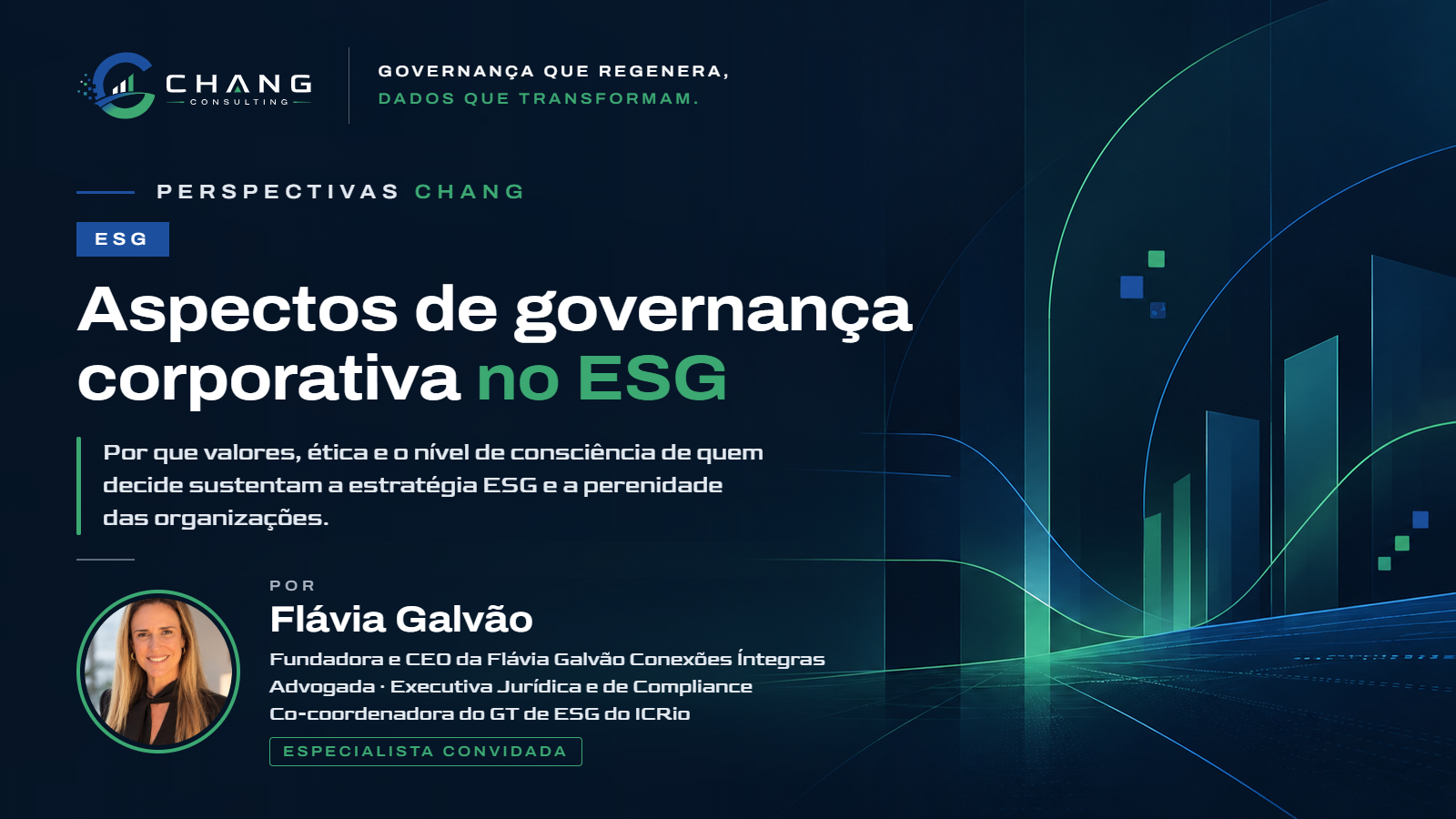
Why values, ethics and the level of awareness of decision-makers sustain ESG strategy and the long-term continuity of organizations.
Chang Perspective · Guest expert: Flávia Galvão, founder and CEO of Flávia Galvão Conexões Íntegras.
The Chang view
At Chang Consulting, we believe ESG is only sustainable when governance stops being a formality and starts guiding decisions, priorities and behaviors. In this edition of Chang Perspective, we invited Flávia Galvão, a lawyer and legal and compliance executive, founder of Flávia Galvão Conexões Íntegras and co-coordinator of the ESG Working Group at ICRio, to discuss how values, ethics and leadership make corporate governance the foundation of ESG strategies.
Governance goes beyond processes
Corporate Governance has been gaining prominence as a supporting pillar of ESG (Environmental, Social and Governance) strategies in corporations, enabling ethical, transparent and responsible practices and promoting the longevity and competitiveness of organizations over the long term.
When people talk about Corporate Governance, the first idea that comes to mind is usually related to structured processes, Compliance rules, risk management and internal controls. However, Corporate Governance goes far beyond these operational aspects. It is the true foundation of values, principles, strategies and organizational culture that, together, make up the company's identity and guide its behavior in the market.
These elements are the pillars of good Corporate Governance, because they are what establish and perpetuate the processes, policies and good practices that reflect the essence of the organization. Corporate Governance, therefore, is not just a matter of form but of substance, because it directly influences how decisions are made and how risks are managed.
To build the rationale for Corporate Governance, one must first consider what guides the organization, how it is perceived and positioned in the market, how it balances stakeholder interests and, above all, what its culture is and how that culture can strengthen or hinder the progress of governance.
The importance of awareness and ethics in Corporate Governance
In this context, the level of awareness of those who make decisions within an organization is decisive for the quality of Corporate Governance. Decision-makers bring with them their values, life stories and biases about the role they play in the organization and how it is reflected in society and the common good. These characteristics shape their choices and the way they balance financial results with long-term objectives.
Leaders focused on immediate returns, without considering the future impacts of their decisions, create serious governance challenges. Pressure for quick financial results, when detached from a commitment to the organization's purpose, puts its very existence and continuity at risk.
On the other hand, ethics is considered a foundation of Corporate Governance, as it underpins decision-making and organizational action, from the most routine to the most strategic. According to the Code of Best Practices of Corporate Governance of IBGC (Brazilian Institute of Corporate Governance), ethics “is the set of values and principles that guides conduct and enables the coexistence and evolution of human beings in increasingly complex societies. It derives from the sense of collectivity and interdependence that drives individuals to collaborate in the development of society, directing their actions toward the common good”.
Therefore, both the level of awareness of decision-makers and ethical commitment are indispensable elements for building strong Corporate Governance, capable of balancing results and values and generating positive, sustainable impacts over the long term.
Consistency between principles and practice: a foundation for business continuity
A company's longevity is directly linked to the value it generates for society. Businesses that pass environmental and social problems on to the world, ignore negative impacts or engage in unethical conduct tend toward obsolescence. The market and society no longer accept companies that disrespect the environment, exploit labor in conditions analogous to slavery or adopt predatory practices. The central question every leader should ask is: does my company add or destroy value?
In this sense, leadership plays a decisive role. An organization's leaders are responsible for setting the tone of corporate culture and for demonstrating, through their attitudes, a commitment to effective governance. Leading by example means setting high standards of conduct, making decisions grounded in ethical principles and ensuring that the organization operates in line with the values it declares. Companies whose leaders embody and reinforce the importance of governance create an environment conducive to strengthening institutional integrity and to a more solid and resilient organizational culture.
Beyond its internal impact, corporate governance should be seen as a strategic asset that generates intangible market value over the long term. Reputation, trust, brand, credibility and integrity are central to a company's attractiveness, competitiveness and continuity. A well-governed organization not only mitigates risks and avoids institutional crises, but also builds healthier relationships with investors, consumers and other stakeholders.
The rewards of effective Corporate Governance are numerous, but we can highlight: access to capital; broader opportunities for growth and business continuity; protection of the organization, whether through stronger compliance programs with more rigorous processes or through the definition of desirable policies and behaviors; operational efficiency, through tools for overseeing and monitoring management; and even the protection of directors and shareholders acting in good faith.
What is on boards' agendas
Not by chance, Corporate Governance topics have been gaining priority on Boards of Directors' agendas, reflecting growing concern with strategic and risk issues. Among the most relevant topics are: monitoring external changes, such as geopolitical crises, conflicts and migration flows; technological advances, especially in generative AI and data privacy; building cyber resilience; climate change; and other environmental, social and governance issues that may have a significant strategic impact on the company. In addition, effective enterprise risk management remains a priority to ensure long-term sustainability and competitiveness.¹
In its Perspectivas 2025 survey, IBGC sought to understand business leaders' perceptions and expectations about the business environment and governance practices in Brazil. Most leaders had a neutral (34.4%) or positive (32.1%) view of the scenario, but factors such as the tax burden, inflation risk, corruption and a lack of skilled labor were identified as potential risks to this optimistic environment. The high cost of complying with tax obligations in Brazil also emerged as a major concern. The study also revealed investment priorities for 2025, notably market expansion (55.3%), human capital (33.2%) and AI (30.4%), topics considered fundamental to the strategic changes of the period.²
Looking ahead, it will be essential for companies to strengthen their resilience, both in cybersecurity and in addressing climate change and social challenges. Investment priorities in market expansion, human capital and AI reflect the need to adapt to technological change and the pursuit of sustainable, innovative growth. Next steps should include strategies that integrate these risks and opportunities, along with constant monitoring of external changes, to ensure effective corporate governance aligned with global trends.
ESG as a strategic pillar, not a trend
In light of the recent backlash against ESG, with companies abandoning social and environmental commitments, it is important for genuinely committed organizations to take an active stance. More than resisting the backlash, these companies should reinforce their commitments and show that ESG is not a passing trend, but a strategic pillar for evolution, progress and continuity. Organizations that embed ESG in their culture will keep investing and moving forward, because they already understand that challenges in this field can and should be turned into business opportunities, driving innovation, resilience and competitiveness over the long term.³
In practice
To assess whether governance is actually sustaining the ESG strategy, an organization can start with five questions:
Dimension | Assessment question |
Risk | Are climate, social, cyber and AI risks mapped and brought to the board's agenda as regularly as financial risks? |
Process | Are the declared values and principles translated into decision criteria, approval authorities and approval routines? |
Control | Are there mechanisms to verify whether leadership decisions follow the code of conduct and the ESG commitments made? |
Data | Are there indicators to track ESG commitments, integrity and reputation over time, and not just in the annual report? |
Technology | Is the monitoring of risks and commitments supported by tools that reduce dependence on spreadsheets and manual consolidation? |
How this topic connects to Chang
At Chang Consulting, this topic connects directly to our ESG and GRC portfolios: we structure governance, risk management and controls so that ESG commitments have an owner, decision criteria and evidence of execution. Indicators and dashboards bring this work closer to Data & BI, allowing boards and leaders to track these commitments with the same objectivity they apply to financial results.
Sources cited by the author
KPMG Board Leadership Center. Board of Directors: priorities for the 2024 agenda (kpmg.com/br).
EY Brazil. Board of Directors priorities for 2024 in the Americas (ey.com/pt_br).
IBGC. Perspectivas 2025 survey (ibgc.org.br/blog/lancamento-pesquisa-perspectivas-2025).
Capital Reset. “If it isn't in the business model, ESG becomes a toll,” says Natura's CEO (capitalreset.uol.com.br).
Chang Perspective
This content is part of Chang Perspective, a series that brings together experts and different perspectives on Governance, Risk, Compliance, ESG, Data and Development. The opinions expressed in this article are the author's.
Want to assess whether your organization's governance actually sustains, in practice, the ESG commitments it has made? Talk to Chang Consulting and schedule an initial assessment.
We also invite you to take the self-assessment on our website, in less than 3 minutes, and we will contact you to analyze your case.
Chang Consulting
Governance that regenerates, data that transforms. · changpartner.com