
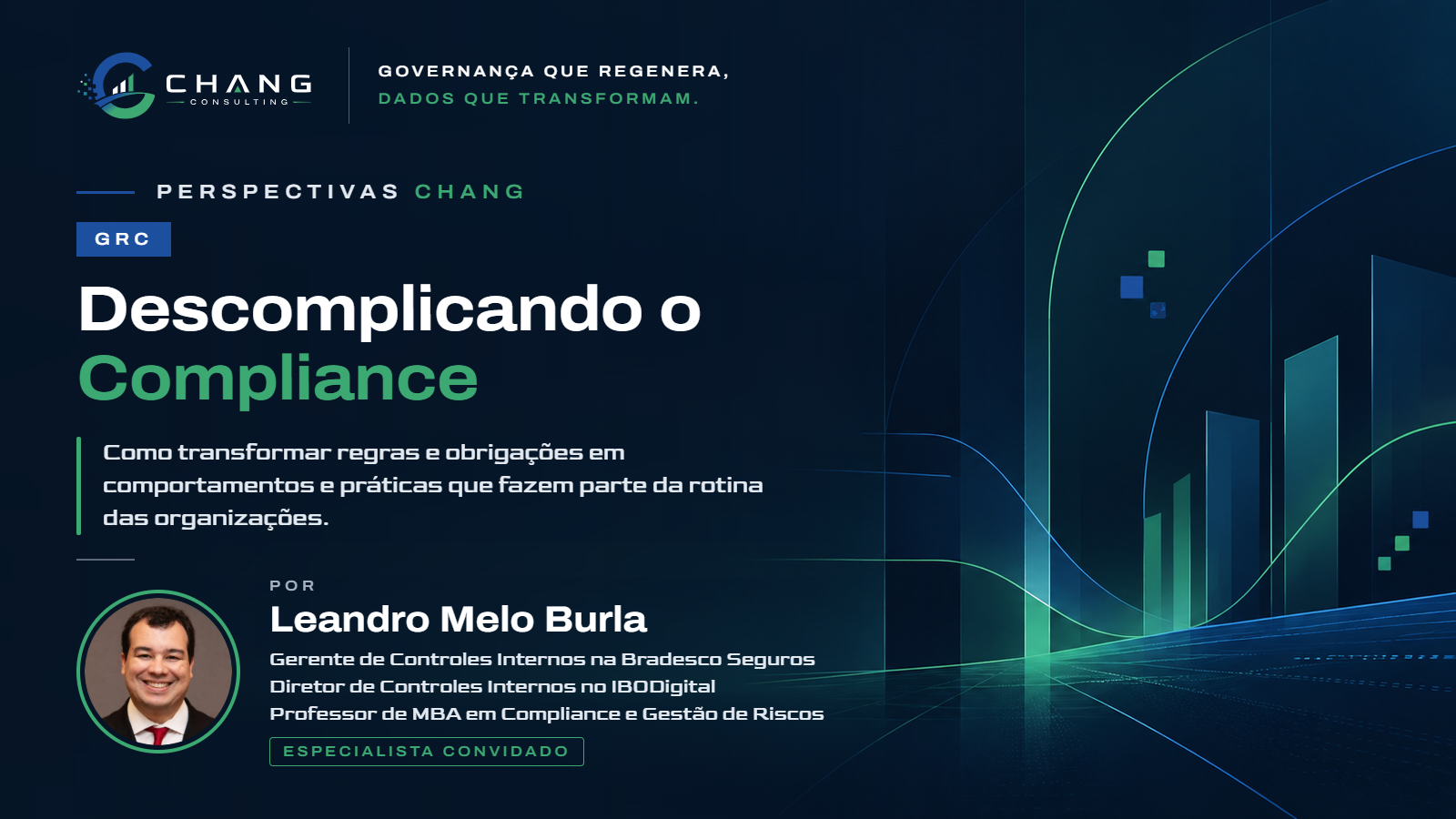
How to turn rules and obligations into behaviors and practices that are part of organizations' daily routine.
Chang Perspective · Guest expert: Leandro Melo Burla, Internal Controls Manager at Bradesco Seguros, Internal Controls Director at IBODigital and MBA professor in Compliance and Risk Management.
The Chang view
At Chang Consulting, we believe Compliance creates value when it guides decisions, processes and behaviors — and is not restricted to policies and documents. In this edition of Chang Perspective, we invited Leandro Melo Burla, Internal Controls Manager at Bradesco Seguros and MBA professor in Compliance and Risk Management, to discuss how a culture of integrity is built into the daily routine of organizations.
Rules everyone understands
The word may sound like jargon, and many people don't really understand what Compliance is. The term comes from the English verb to comply, which means “to be in conformity,” referring to laws, rules and regulations.
But isn't this article supposed to demystify it?
Here we go. Rules and laws are the basis of how society works every day. Take traffic laws, for example. They apply to everyone, drivers and pedestrians alike. A traffic light is a simple code: red, stop. Green, go. And yellow, caution. If it's green for pedestrians, it's red for drivers, and vice versa. Yellow is a transition element. Here, the traffic light is a simple tool for conveying these rules and keeping traffic flowing naturally. We learn these codes as children, from our parents and at school, and more deeply, along with other theoretical and practical knowledge, when we get our driver's license at 18.
And what happens when these laws and rules are broken? All kinds of trouble: from arguments, fines and fender-benders to more serious accidents, such as pedestrians being hit and major damage that can lead to injury and even death. Along with that come lawsuits, which extend the consequences of distraction or irresponsibility to companies and families, long after the pieces have been picked up and traffic is flowing again.
Compliance applies to everyone
Laws apply to individuals and legal entities. That is why they apply to all organizations, whatever their type and size: from the largest corporations to neighborhood stores; from the largest federal agency to a small public office in a country town. Staying in compliance has to be permanent. This ranges from the simplest obligations, such as paying bills and taxes, to the most complex, such as accounting and tax calculations. On top of that come the specific regulations for each line of business, set by regulators and government agencies. Add to this the complexity of being accountable through audits, accreditations, assurance...
(Stressful, isn't it?)
Compliance as a daily attitude
The path to compliance begins by making all employees aware that Compliance is not an obligation, but a daily attitude. Doing the right thing is the basic component of professional activities and even of living in society. Just like in traffic, when everyone does their part, everyone benefits.
When every professional is compliant in their daily work, they help preserve the organization's assets, especially something valuable even if intangible: its reputation. This “credit” makes interactions with stakeholders easier: customer preference and loyalty; credibility with regulators and government bodies; value for shareholders and investors; bargaining power and strategic partnerships with suppliers.
As a result, people come to understand the purpose of their work, which enables engagement and better results. This prosperity contributes both to the success of the business and to professional development.
Compliance functions in organizations were not created just to determine which external rules apply to the organization's activities, nor only to create internal rules. One of their goals is to spread a culture of integrity aligned with the organization's codes, culture and context. This approach needs to be dynamic and light so that professionals understand the concepts and relate them to their daily work, seeing value and adopting these attitudes naturally. This communication needs to extend across the entire value chain, reaching suppliers and being visible to customers and regulators.
When the organization is not in compliance
In the example above, we discussed the consequences for citizens when they don't comply with traffic laws. But what are the consequences for organizations when they are not in compliance? Fines, complaints and lawsuits (from customers and former employees) end up diverting focus from productive capacity and purpose toward spending effort (and resources) on “putting out fires” caused by... distraction or irresponsibility, even after the day's mess has been sorted out, everyone has logged off and it's time for #FridayFeeling.
Compliance Risk (the risk of legal sanctions, financial losses or reputational damage from violating regulators' rules) is one of the most complex types of risk, because its impacts are immeasurable in financial terms and unpredictable in scope. For example, how can you ensure that a single professional's misconduct is not interpreted by the authorities as criminal association? If the company's shares are traded on the capital markets, how do you calculate how far the share price will fall and for how long? How much can operations suffer from an exodus of customers and suppliers? How many fines, and which ones, will the organization face by the end of the investigations?
Prevention is better than cure
Of course, prevention is better than cure. That is why Compliance activities are preventive in nature, following a soft control approach. To prevent legal risk from materializing, constant oversight is needed to verify whether compliance is actually being achieved in processes and controls. This additional verification is carried out by other areas of the enterprise risk management structure, such as Internal Controls and Risk Management, which take a hard control approach. But that's a topic for future articles.
I hope this has served its purpose. I look forward to your feedback and am happy to clarify and discuss this and other topics on my social media.
In practice
To assess whether Compliance is connected to daily routine, an organization can start with five questions:
Dimension | Assessment question |
Rules | Are the applicable obligations identified and explained in language that teams understand? |
Responsibilities | Do people know what is expected of them and whom to turn to when in doubt? |
Processes and controls | Have the rules been translated into steps, responsibilities and evidence of execution? |
Culture | Do communication and training help guide real decisions, beyond recording attendance? |
Monitoring | Is there evidence or are there indicators that make it possible to identify failures and opportunities for improvement? |
How this topic connects to Chang
At Chang Consulting, this topic connects to our GRC portfolio, which brings together governance, risk, Compliance and internal controls. Indicators and dashboards bring this work closer to Data & BI, while automating steps and checks connects the topic to our Development portfolio. That way, control can be part of the operation instead of existing only as a document.
Chang Perspective
This content is part of Chang Perspective, a series that brings together experts and different perspectives on Governance, Risk, Compliance, ESG, Data and Development.
Want to understand how to turn Compliance obligations into processes, controls and practices that fit your organization? Talk to Chang Consulting and schedule an initial assessment.
We also invite you to take the self-assessment on our website, in less than 3 minutes, and we will contact you to analyze your case.
Chang Consulting
Governance that regenerates, data that transforms. · changpartner.com