
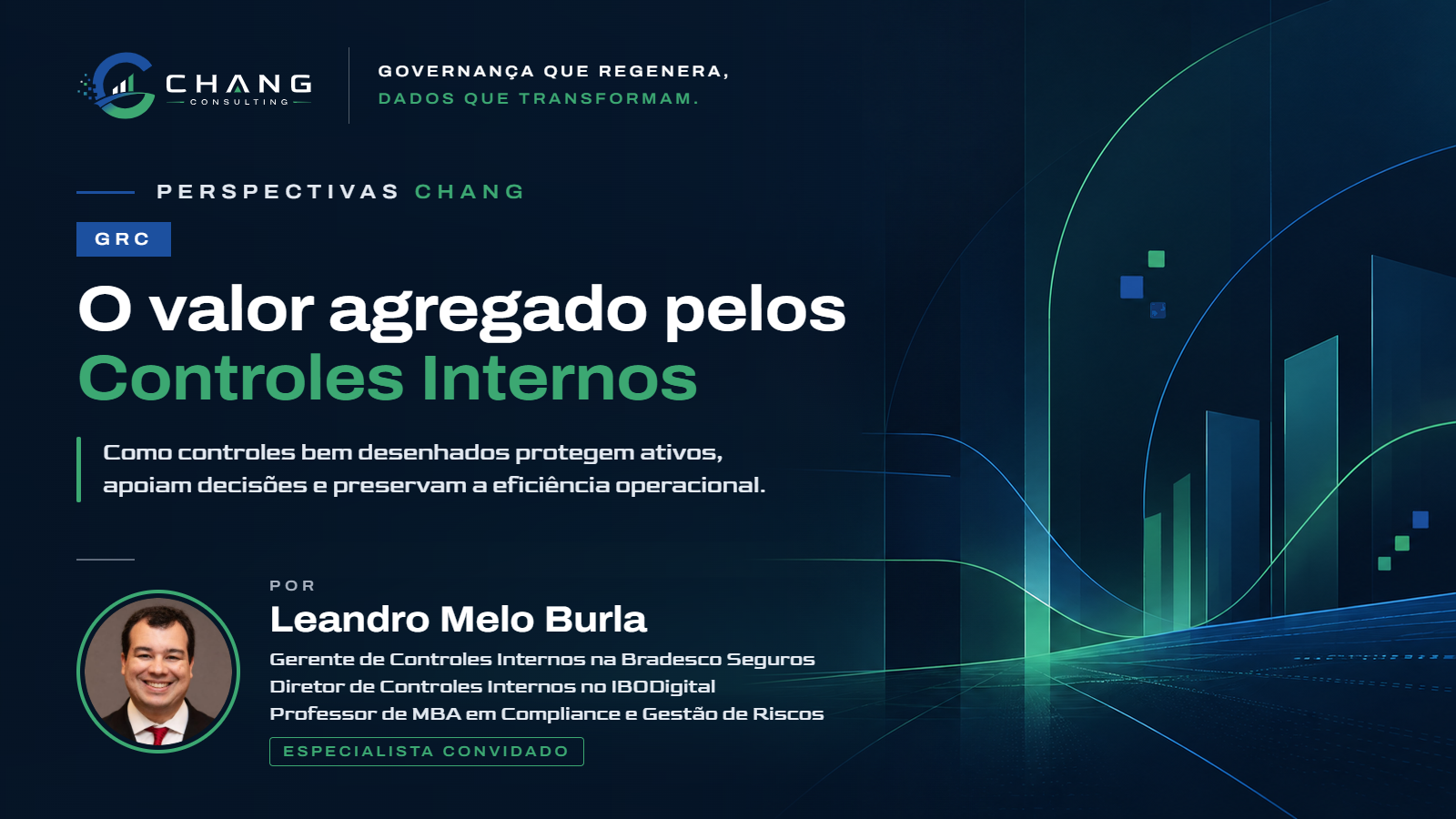
How well-designed controls protect assets, support decisions and preserve operational efficiency.
Chang Perspective · Guest expert: Leandro Melo Burla, Internal Controls Manager at Bradesco Seguros, Director of Internal Controls at IBODigital and MBA professor in Compliance and Risk Management.
The Chang view
At Chang Consulting, we believe internal controls create value when they are built into processes, proportional to risk and supportive of the organization's decisions. In this edition of Chang Perspective, we invited Leandro Melo Burla, Internal Controls Manager at Bradesco Seguros and MBA professor in Compliance and Risk Management, to discuss how this function can protect assets without compromising operational efficiency.
Control is not a synonym for bureaucracy
“Here comes the Compliance crowd.” These days, it is a common line in office corridors. Or the sudden silence in meeting rooms, in person or online, when someone from the corporate risk team walks in. But within the “Compliance” spectrum, there are teams of professionals with different roles, including Internal Controls professionals.
The Portuguese language gives the word “controle” a wide range of meanings. Unfortunately, for many professionals, “control” carries a connotation of bureaucracy. Put more colloquially: a stuck wheel, an anchor...
However, the word comes from the medieval Latin contrarotulus, formed by joining contra (“against”) and rotulus (“roll”, “writing” or “record”). It passed into French as contre-rôle or contrôle (literally “counter-roll” or “copy of a record”), evolving into the act of checking, inspecting and overseeing. Notice that the goal of safeguarding assets is already there.
From classical theory to the concept of Internal Controls
Later, in 1916, Henri Fayol launched the Classical Theory of Administration, placing Control among the basic functions, alongside Forecasting, Organizing, Commanding and Coordinating. Another classic management saying, attributed to William Deming (one of the architects of Quality Management) or to Peter Drucker (one of the most brilliant minds in Management), around the mid-1960s, reinforces the importance of the topic:
“You cannot measure what you cannot control.”
When we talk about measuring, we cover many factors: assessing quality, calculating results, checking return on investment... once again, with the aim of preserving the organization's assets. Professor Silvio Crepaldi (2013) describes Internal Controls as:
“Procedures, methods or routines whose objectives are to protect assets, produce reliable accounting data and help management conduct the Organization's business in an orderly manner.”
Control is everyone's duty
Even with these concepts in place, one of the many challenges for Internal Controls professionals is raising awareness that control is more than a duty: it is a necessity. People needed to realize that looking after controls (and, in doing so, protecting the organization) is everyone's duty, understood as a purpose. More than that, it is an opportunity to deliver results safely.
But how do you balance the effort between safety and controls without hurting the pace of work or weighing down deliveries? The path lies in strengthening a culture of risk and control awareness among business professionals. No one is better placed than managers and their teams to know the most critical points of their processes, their dynamics and the impact of failures. So, drawing on their experience and reality, they naturally run controls that are smooth, safe and effective.
The independent eye of Internal Controls
On the other hand, this day-to-day expertise does not exempt control teams from making their own contribution. An external, independent eye has no bias, fatigue, preferences or sensitivities. Essentially, the primary role of Internal Controls is to develop methods to assess the effectiveness of the controls performed across the organization's value chain, preventing inherent risks from materializing. In this way, it lends its risk expertise, keeping the organization from “putting out fires” and allowing attention to stay on deliveries and results.
These assessments are carried out through tests on the controls implemented by the business areas, to evaluate whether they are sufficient to prevent risk exposure. This is a hard control approach. The mapping of risks linked to the organization's processes is recorded in a Risk and Control Matrix, with probability and impact ratings, as well as a severity assessment should those risks materialize. All analyses should be grounded in qualitative and quantitative criteria, based on the methodologies the organization considers best suited to its type of business, culture or organizational characteristics.
Reinforcing the concepts above, we cite the view of COSO (Committee of Sponsoring Organizations of the Treadway Commission), one of the world's main frameworks on the subject, which describes internal control as:
“A dynamic and integrated process, carried out by the board, managers and employees, to provide reasonable assurance that the organization's objectives will be achieved.”
Internal Controls as a risk advisor
The results of these analyses do not always confirm that the procedures managers consider best address every risk, or that they are the most efficient or effective. Even when no risk exposure is identified, there may be a missed opportunity to produce more and better. So the role of Internal Controls professionals had to evolve into that of risk advisors, contributing not only to detecting and preventing risks but also to the rational use of resources to seize opportunities.
Talking about risk should not be taboo, an unpleasant subject that strays from the purpose of everyday work. It should not be treated as a “separate” topic, but as part of the basic functions, built into decision-making. This attention becomes even more crucial today, when losses from risk exposure can affect competitiveness and relationships with stakeholders.
Control by design
Organizational processes change constantly, and this naturally changes risks and their controls. That is why, ideally, processes should be designed with risk-mitigating controls built in from the start, without affecting productivity and while maximizing opportunities. In other words, control by design. Some examples: implementing automation and defining risk indicators tied to operations, such as risk tolerance metrics.
Artificial Intelligence, data and controls
Finally, since we are talking about today's disruptive frontier, Artificial Intelligence, Internal Controls professionals have been succeeding in applying these technologies. Well-crafted prompts, well-built AI agents, bots and automation applied to test plans have brought efficiency, quality and accuracy to the analyses.
A very current example lies in a need every organization shares. Data is the new oil and the engine of Artificial Intelligence. Good practices for protecting company data start with establishing Data Governance, with roles, responsibilities, rules... and risk analysis. That is where controls come in, preventing risks and bringing more security to new operations... acting as an enabler of innovation and efficiency gains...
So, who said control is mere bureaucracy? In upcoming articles, we will talk a little more about the other side of the coin: risks and enterprise risk management.
I hope this article has served its purpose. I look forward to your feedback and am available to clarify and discuss this and other topics on my social media.
In practice
When assessing the controls of a process, it helps to turn the discussion into objective questions:
Dimension | Assessment question |
Risk | What event could compromise the process objective, and what would its consequences be? |
Process | Where are the critical steps, the handoffs between areas and the points prone to failure? |
Control | Who is responsible, how often does the control run and what evidence shows it was performed? |
Data | Which indicators or evidence help identify deviations and track risk exposure? |
Technology | Are there repetitive activities that can be automated in a way that is safe, traceable and proportional to the risk? |
How this topic connects to Chang
At Chang Consulting, this topic connects mainly to our GRC portfolio. When risks and controls are translated into indicators, dashboards and monitoring mechanisms, the work also connects with Data & BI and Development. This integration brings risk assessment closer to day-to-day operations and supports decisions with processes, evidence and structured information.
Chang Perspective
This content is part of the Chang Perspective series, which brings together experts and different perspectives on Governance, Risk, Compliance, ESG, Data and Development. The opinions expressed in this article are the author's.
Want to assess whether your organization's controls are aligned with its risks and operations? Talk to Chang Consulting and schedule an initial diagnostic.
Chang Consulting
Governance that regenerates, data that transforms. · changpartner.com